Welcome to EquiAccess

Accessible Healthcare. Thriving Communities.

We bridge the gap between clinic and home with private, offline tools for underserved communities.

Our mission

Our mission is to advance health equity by helping communities and individuals navigate their healthcare journey. We strive to solve global health issues such as the digital divide, and to expand access to care for underserved populations worldwide.

Our Bridge Framework

The Six Keystones

Every EquiAccess project stands on the same six keystones. Together they aim at realizing SDG 3, good health and well-being for all.

Click a keystone to see what it means.

Communities facing barriers SDG 3 good health & well-being for all 1 Breaking Barriers 2 Resource Provision 3 Inclusive Design 4 Digital Support 5 Guidance 6 Equitable Impact

Projects

What we're building.

01
In development

The EquiAccess Indexer

A private, offline health tracker and triage indexer for communities without easy access to a clinic, built first for rural sub-Saharan Africa and South America.

Dr. Rita Orji grew up a two-hour walk from her nearest clinic. Her story is why the Indexer exists: to bring the first steps of care closer to home.

A

Tracks health over time

Monitors health information across multiple visits in a private, encrypted local record.

B

Pathways, helped by AI

Follows clinical pathways such as OLDCARTS. A fine-tuned Llama 3.2, trained on real patient and doctor conversations, helps phrase the questions. It never makes the decisions.

C

Private, local & inclusive

Fully offline. Works regardless of literacy level or dialect, with speech in and speech out.

How a visit flows

  1. 1
    Verification and Vitals

    Every visit starts with a user verification, both by date of birth and pin/keyphrase. Then, basic vitals are taken.

  2. 2
    Symptoms

    These questions are fixed and never change. They are supposed to gage energy level, overall mental state, and overall physical state.

  3. 3
    Guided Questioning

    From information gathered in the previous steps, a clincal pathway is chosen. This continues until enough patient information is collected for next steps.

  4. 4
    Flags

    Answers are checked against fixed danger-sign rules. Our AI never decides these, although it can help reveal flags.

  5. 5
    EquiAccess Index

    A transparent priority score for clinician review. This is based off of flags and is mostly deterministic.

  6. 6
    Report

    A PDF goes to the clinician, and the visit joins the patient's encrypted history.

deterministic engine    AI assists phrasing only

What the AI learned from

One rule shapes every choice: no synthetic data, ever. The model learns to phrase questions only from real clinical conversations between real people, used under licenses that permit it.

MIT
MTS-Dialog

Real doctor and patient clinical dialogues.

3,500+ real doctor questions
CC BY 4.0
PriMock57

57 primary-care consultations recorded with real clinicians.

1,900+ real doctor questions

What to ask, and which signs are dangerous, is written by people from public-domain MedlinePlus references, never trained into the model. The AI never diagnoses, never decides urgency, and every question it writes must clear a guardrail before a patient sees it.

A live demo is on the way

We are finishing the deterministic engine that drives every visit. Once it is solid, an interactive walkthrough will live here so you can see exactly how a check-in flows, start to finish.

02
Upcoming

Digital Literacy & Accessible Software

An easy-to-navigate online platform for learning digital literacy, health-related and beyond, and for getting assistive software into more hands.

Learn

Approachable digital-literacy lessons for everyone, whatever the starting point.

Access

Assistive software, such as screen readers, brought to the people who need it.

Equip

The goal: eventually providing assistive hardware such as wheelchairs and hearing aids.

Activities · 2026

A youth voice at the
United Nations.

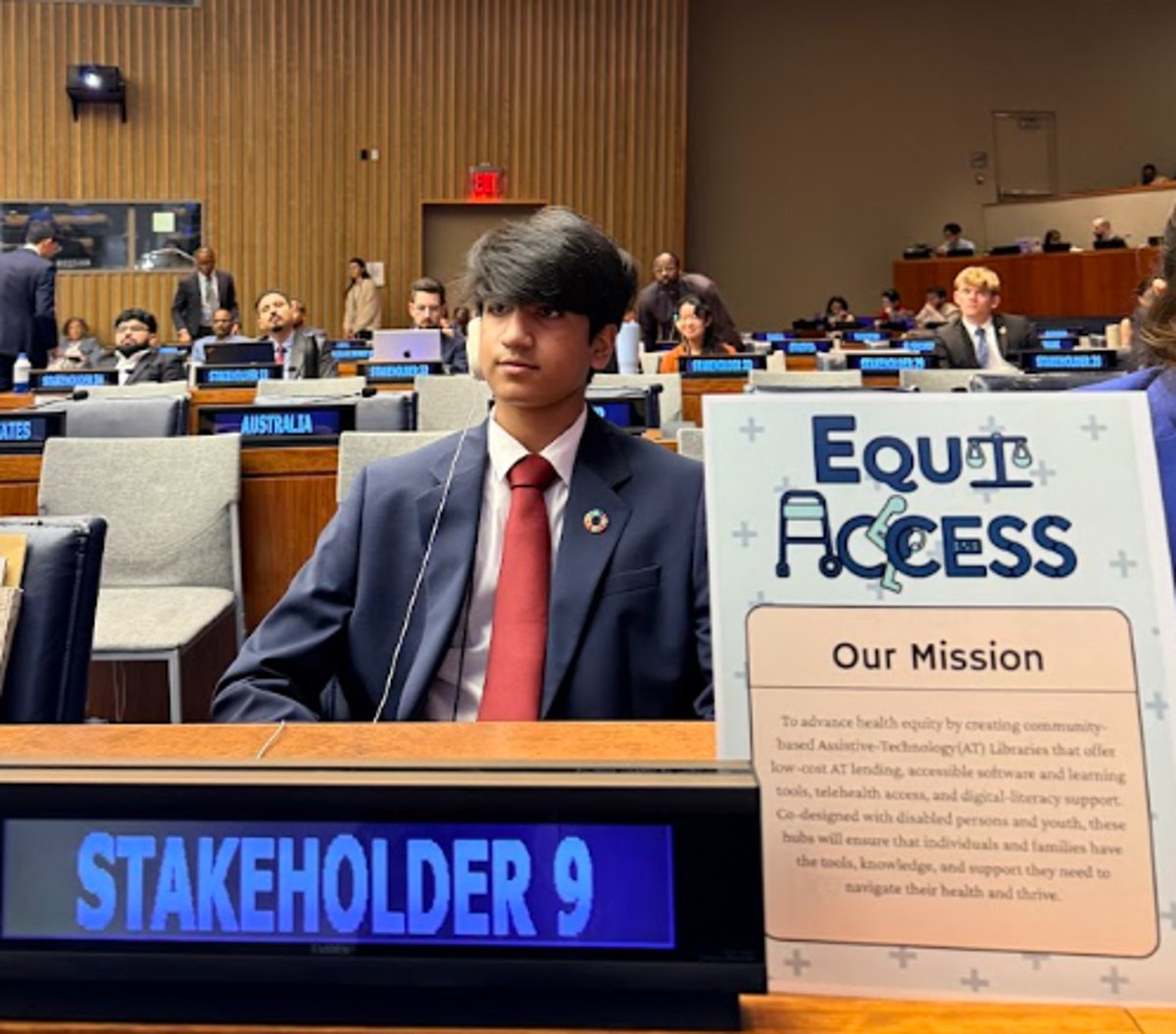
Nikhil, founder of EquiAccess, at the United Nations
UN Headquarters, New York
2026

11th STI Forum

Multi-Stakeholder Forum on Science, Technology & Innovation for the SDGs

Nikhil Surya, founder of EquiAccess, was invited to engage with global leaders, innovators, policymakers, and researchers on the questions shaping the future of technology.

Nikhil attended as the founder of EquiAccess. He left the Forum with a deeper understanding that the hardest part of innovation is not the technology itself, but making sure it reaches the communities that need it most.

Nikhil with President Elect of the WFEO K.N. Gunalan.
Nikhil and KN Gunalan
Side event

Engineering a Sustainable, Resilient Built Environment

How emerging technologies can build infrastructure that withstands climate and resource pressures while remaining accessible to developing regions.

“The most effective technology is not always the most advanced one. It is the one that is resilient, scalable, and usable where people actually are.”

Nikhil at Microsoft's dialogue session
Microsoft dialogue session
Dialogue session

AI & Innovation: The Future of Job Creation

Microsoft's session explored how companies are approaching the future of work, where up to 400 million jobs could be tied to AI and digital transformation by 2035. Speakers included Naria Santa Lucia, Ambassador Shea Gopaul, and H.E. Cornel Feruta.

“Closing the AI skills gap requires closing the access gap underneath it.”

EquiAccess mission card at the delegate desk
Representing EquiAccess
At the delegate desk
At a side event
STI Forum backdrop
At the STI Forum
Nikhil with H.E. Lok Bahadur Thapa
With H.E. Lok Bahadur Thapa, ECOSOC President

Get involved

Help us build the bridge.

Clinician, translator, engineer, or community partner: if our mission resonates with you, we would love to hear from you.

equiaccessorg@gmail.com